Everything the home needs to run
Eight rooms of work, plus who is allowed in each. This is the product, not a feature list for a slide: what the household actually does in Homnest, and what we deliberately do not do.
There is no Google Calendar sync, no bank login, and no SMS. The household runs here. Open a room, then download the app — the 14-day trial starts on your first home.
The whole home on one week.
Calendar
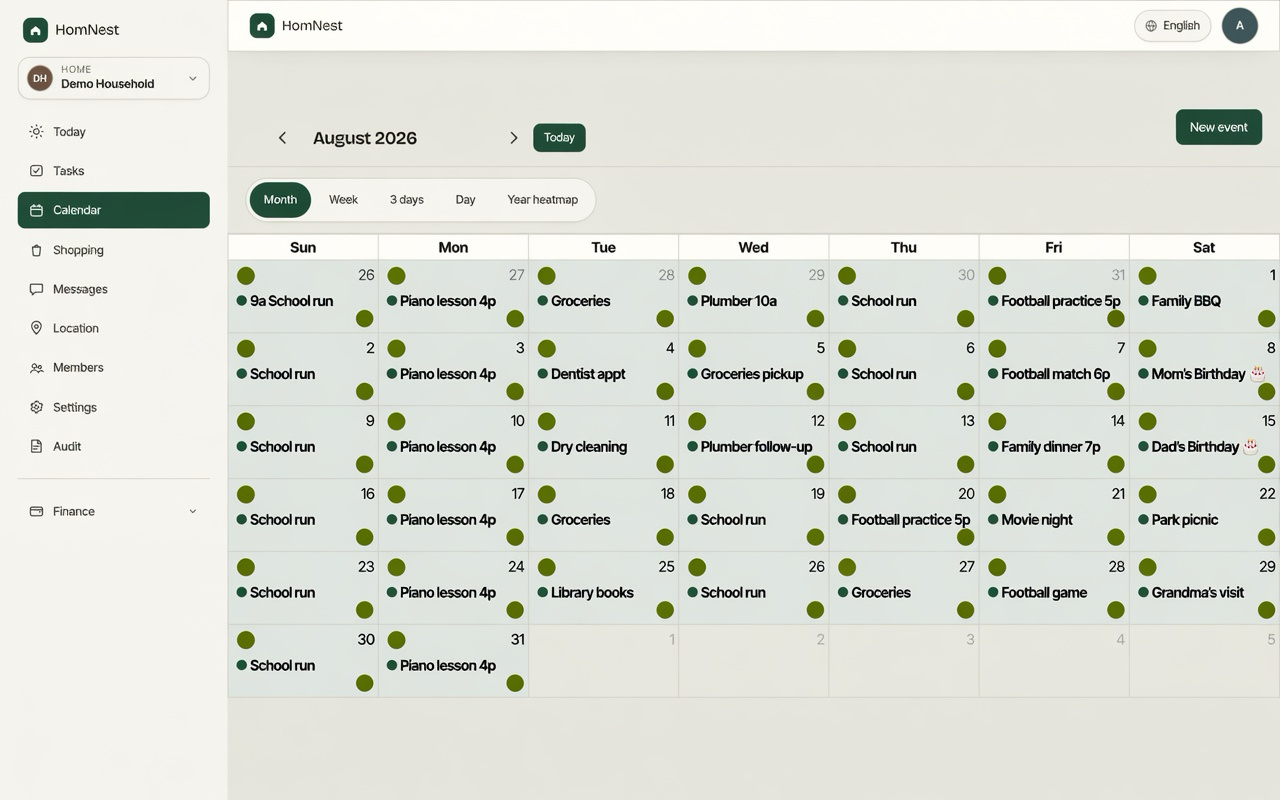
The household week is one picture: school runs, practices, birthdays, the plumber, a dinner that actually has a time. Recurring events, reminders you can snooze from the lock screen, and saved filters so each person can look at their slice without losing the family view.
There is no Google, Apple or Outlook sync on purpose. A household calendar is not a personal calendar leaking into work. Everyone with permission sees the same week; children and teens only see what their role allows.
- Week, month and agenda views for the whole home — not eight personal calendars taped together.
- Snooze or mark done from the notification, on iPhone and Android.
- This calendar belongs to the home. No external calendar sync, by design.
Who said they would do it.
Tasks
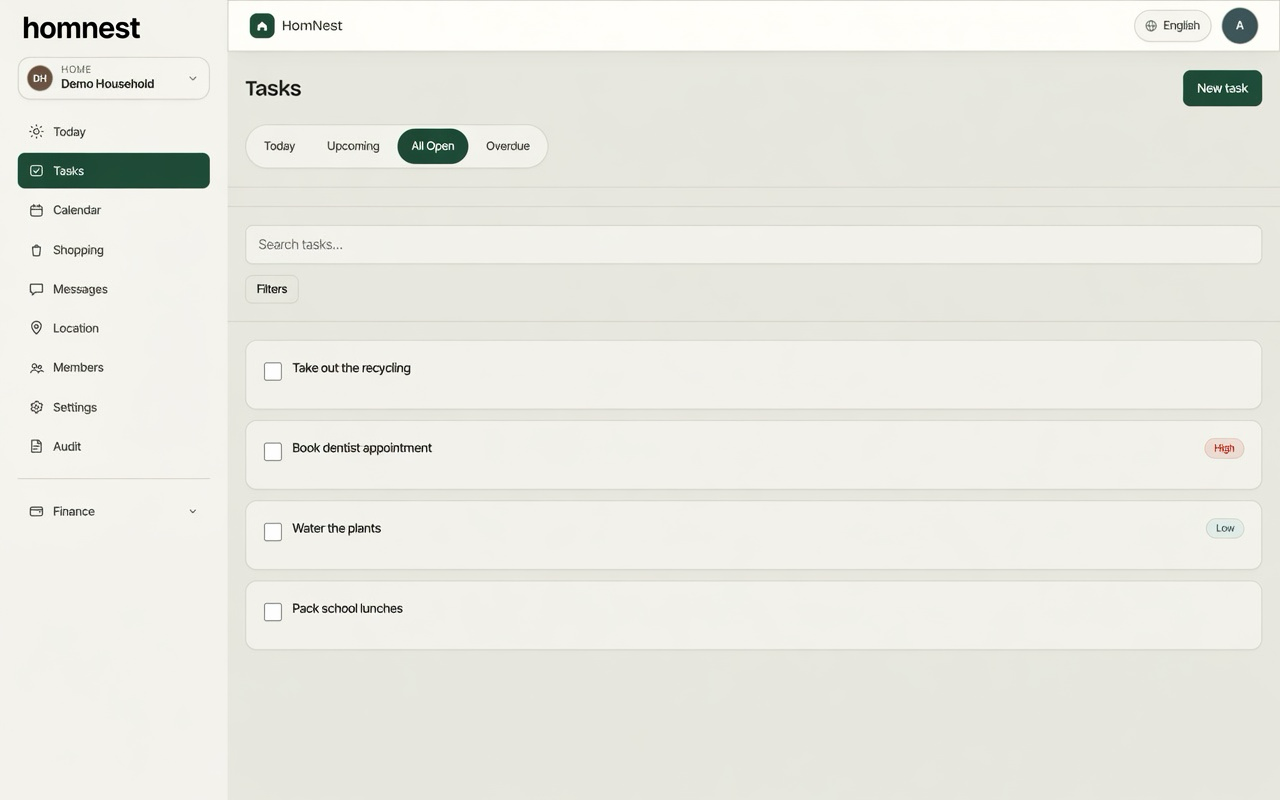
A household runs on promises: who takes the bins, who calls the school, who deals with the insurance. Homnest turns that into tasks with an owner, a due date, and a record — not a message that scrolled away on Tuesday.
Templates cover the repeating work. Conflict checks catch two people booked for the same slot. Roles decide who can assign what, and what a child is even allowed to see.
- Assign a person, a due date, and a home — with a history of who changed what.
- Templates for the work that comes back every week, not a blank list every Sunday.
- Children and teens see the tasks meant for them, not the adults' queue.
What the house spent this month.
Money
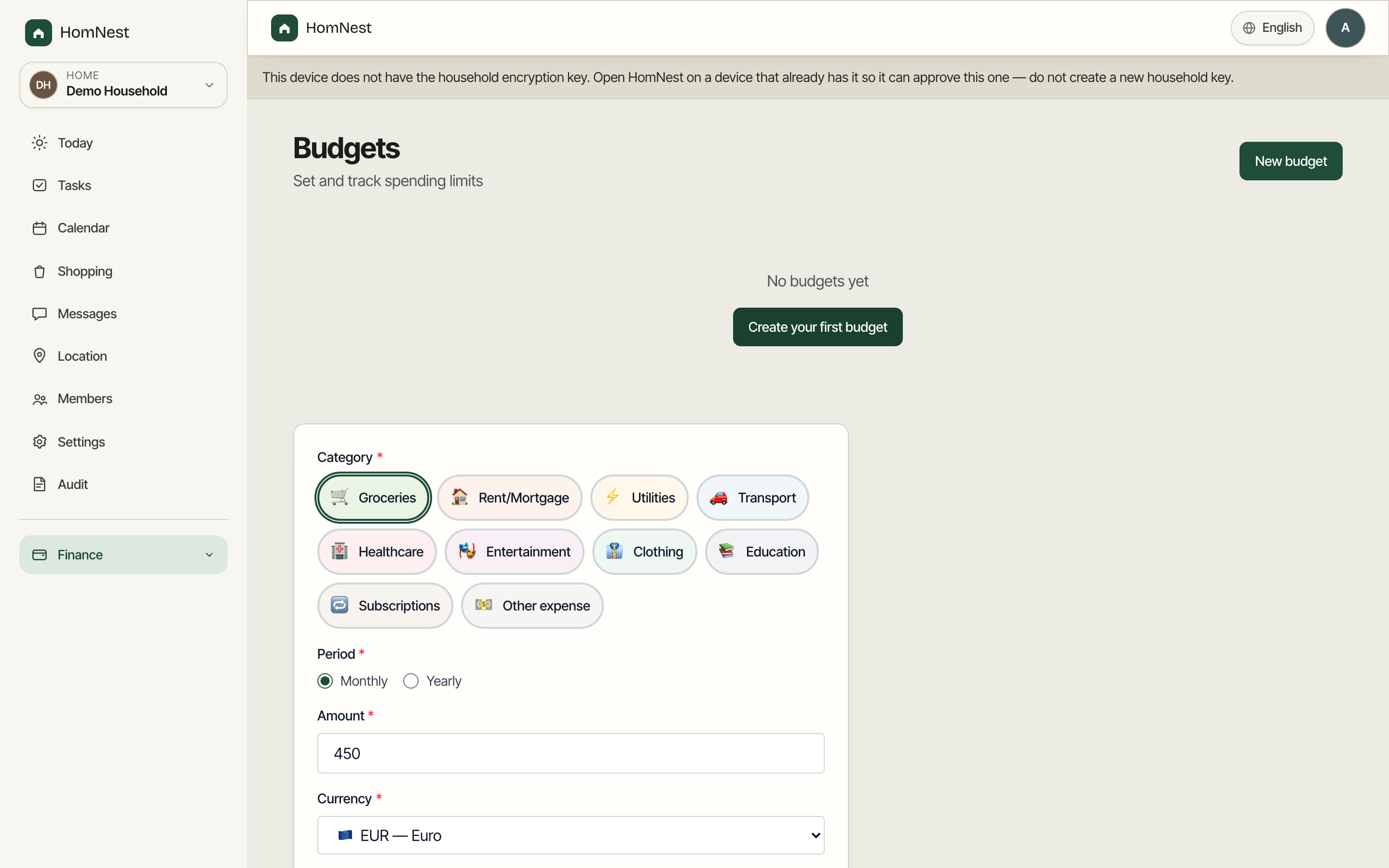
Household money is not a personal banking app. It is the picture of what left the house this month: groceries, cash, a shared card, the class trip, the repair. Homnest keeps budgets, envelopes and savings in one place the adults of the home can actually see.
There is no bank login and no PSD2 connection — on purpose. You enter what was spent. The server stores it encrypted at rest; it is not end-to-end, so the home can still export it later. Receipt photos, if you attach them, are end-to-end.
- Monthly picture of household spend, with budgets and envelopes — not a personal bank feed.
- No bank connection. You stay in control of what is written down.
- Savings goals sit next to the month, so a trip or a boiler is not a surprise in the chat.
One list, not four.
Shopping
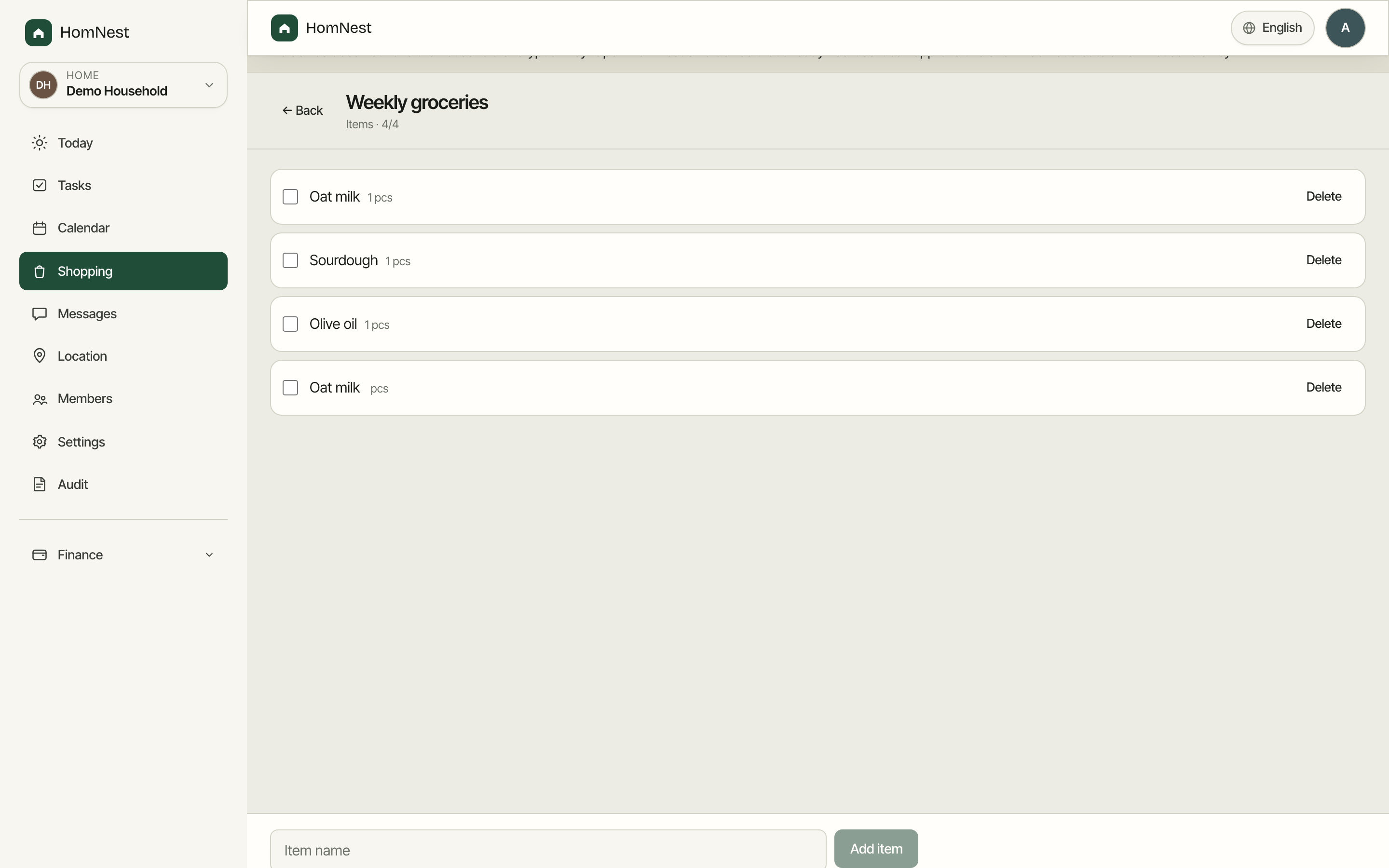
The shopping list is the most stolen object in a house: a note on one phone, a message in the chat, a paper on the fridge. Homnest keeps one list the whole home can add to, tick off in the aisle — including offline — and finish without a second round of 'did you get milk'.
When the trip is done you can attach a receipt photo. That photo is end-to-end encrypted. If you want the spend in the household money picture, you can turn the trip into a finance entry without retyping the shop.
- One shared list, on every member's phone, including offline tick-off.
- Receipt photos are end-to-end. The server cannot read them.
- A finished trip can become a household money entry, instead of dying in the chat.
Family chat the server cannot read.
Messages
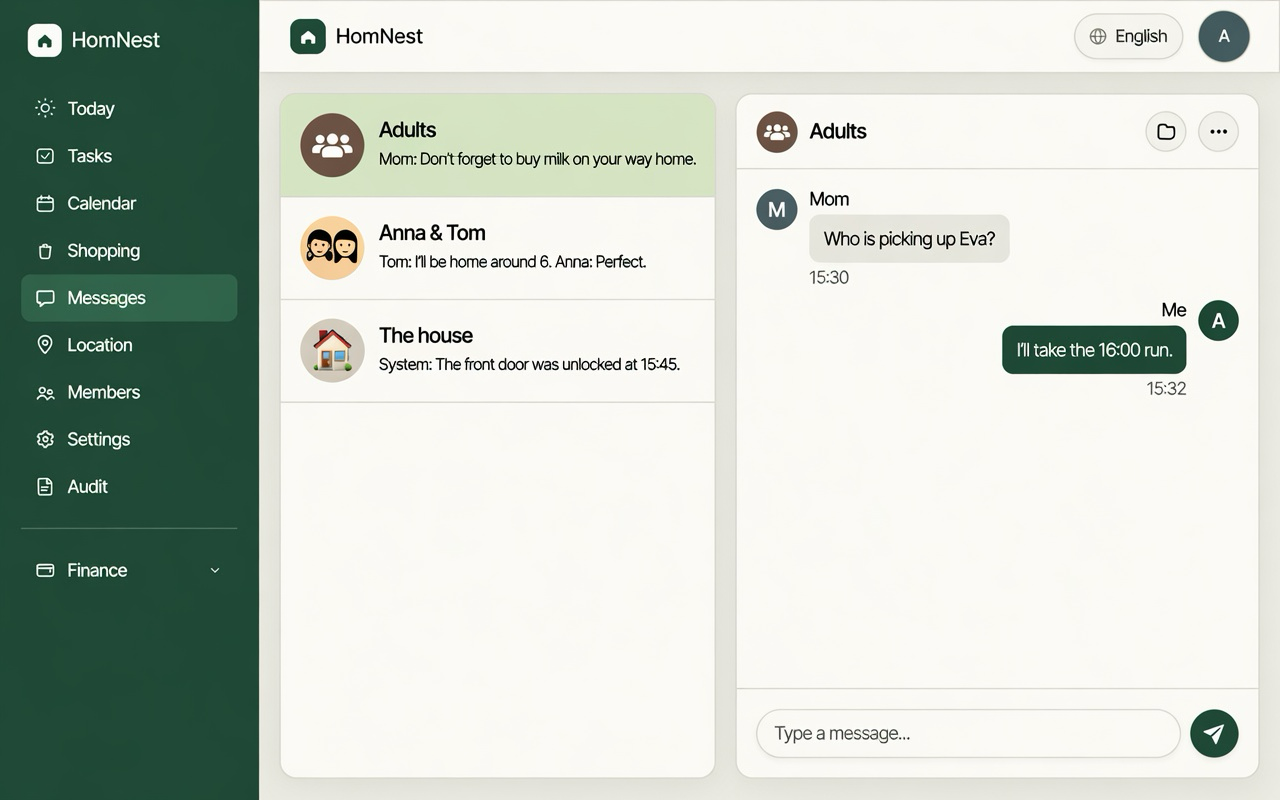
A household still needs to talk — without putting the family chat on a server that can read it. Homnest messages are end-to-end encrypted: text, voice notes, photos, files. We cannot read them. Mentions and search run on your devices, not as a readable index in our database.
This is not a public social network. It is the home's rooms: the adults, a parent and a child, the whole house. History rules respect when someone joined. Attachments follow the same lock as the message.
- End-to-end for text, voice, photos and files. Zero-knowledge on our side.
- Mentions and search stay on the devices in the home.
- Rooms for the household — not a feed, not a public profile.
A real call, not a browser tab.
Calls
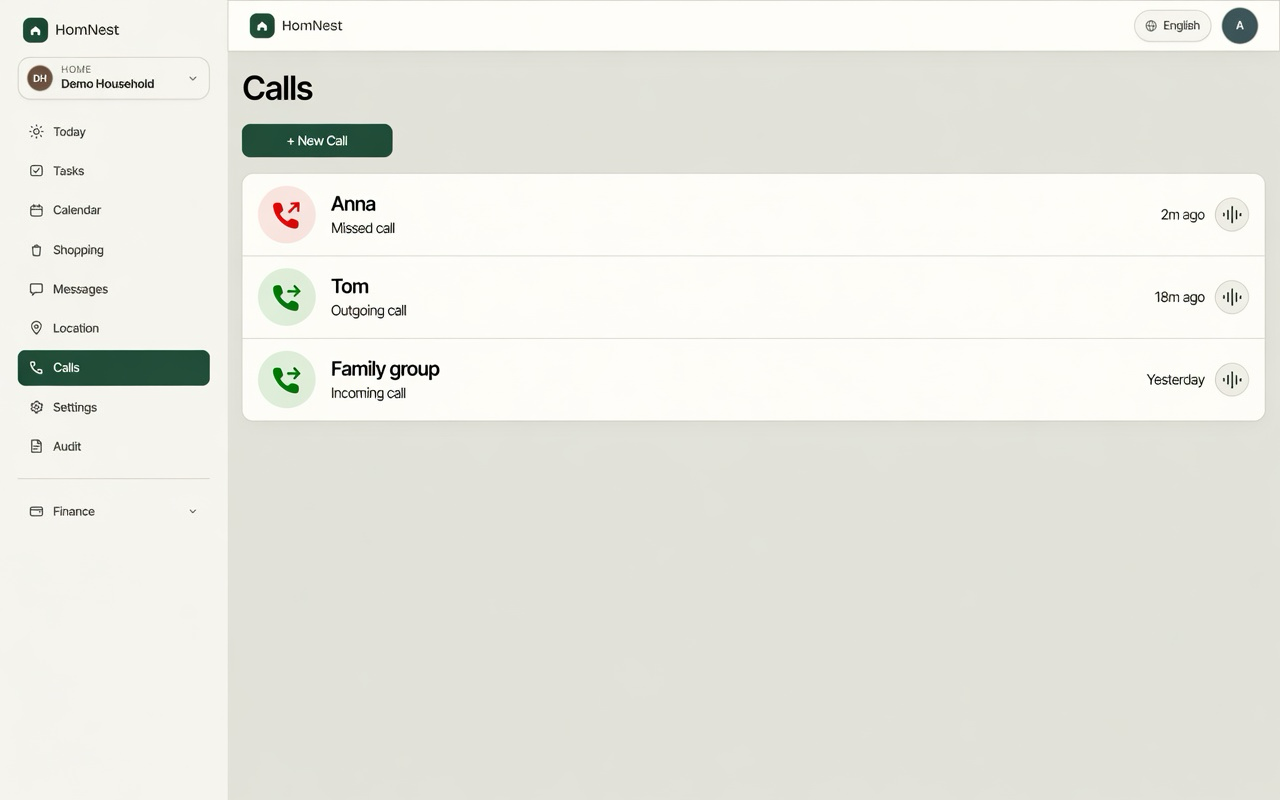
When the chat is not enough, you call. Homnest calls are peer-to-peer between the people in the home: one-to-one, or a small group of up to four. On the phone it uses the native call screen, so it rings like a call — not like a muted browser tab.
Optional recording is end-to-end encrypted, same as messages. There is no SMS, no extra per-minute bill, and no outside conferencing account. A missed call can notify the home without exposing what would have been said.
- Native ringing on iPhone and Android, including from the lock screen.
- One-to-one or a small group. No extra conferencing subscription.
- Optional recording is end-to-end. We cannot play it back.
On the map, only if they opted in.
Location
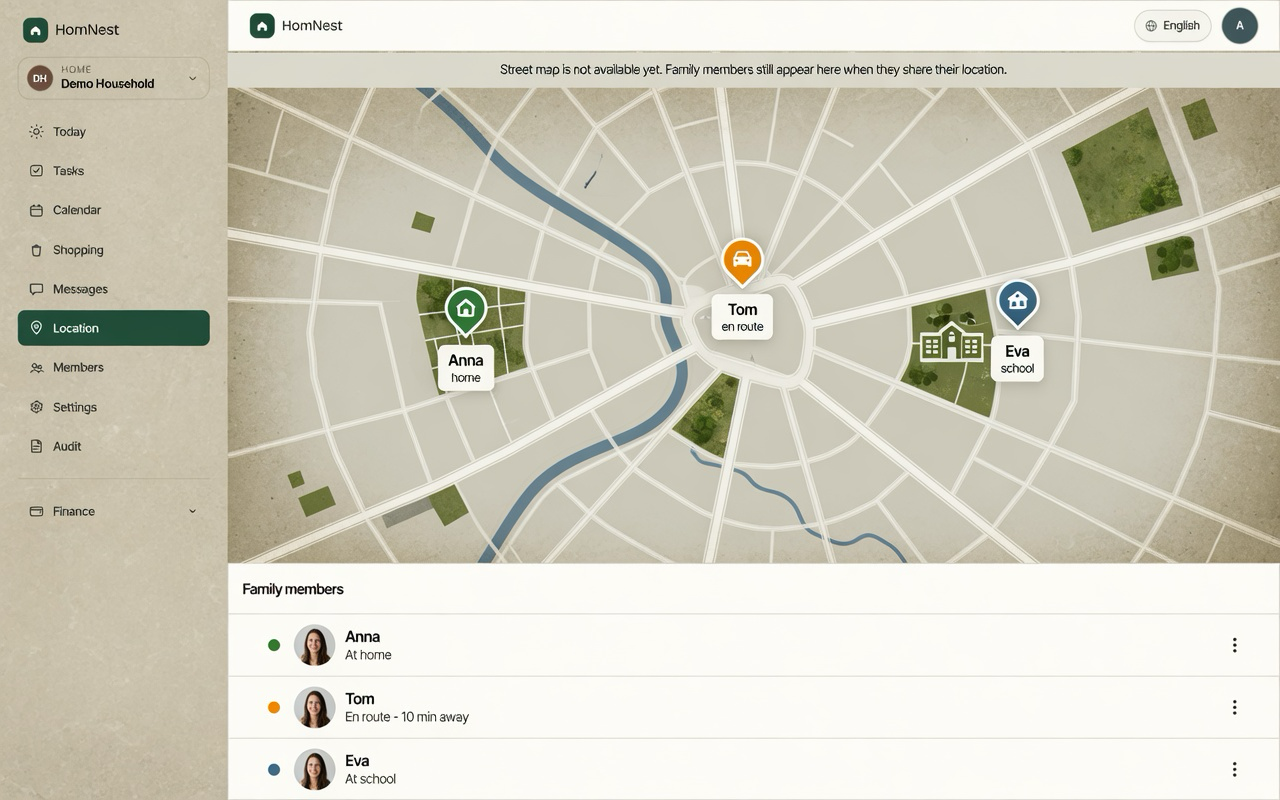
Location in a household is a permission, not a default. Each person opts in, and chooses a precision: city, about a hundred metres, or exact. Ghost mode and schedules exist for the hours when sharing should be off. The map is for the home, not for us.
Live pings, history, favourite places and geofences are end-to-end encrypted. The server and the websocket never see coordinates — only ciphertext. During an SOS, sharing can switch to exact for a short window, still encrypted, still only for the home.
- Opt-in per person, with a precision they (and the home's rules) can live with.
- The server never sees latitude or longitude. Only locked data.
- Ghost mode, schedules, and a temporary SOS override — not a tracker left on forever.
Ten seconds, then the home is told.
SOS
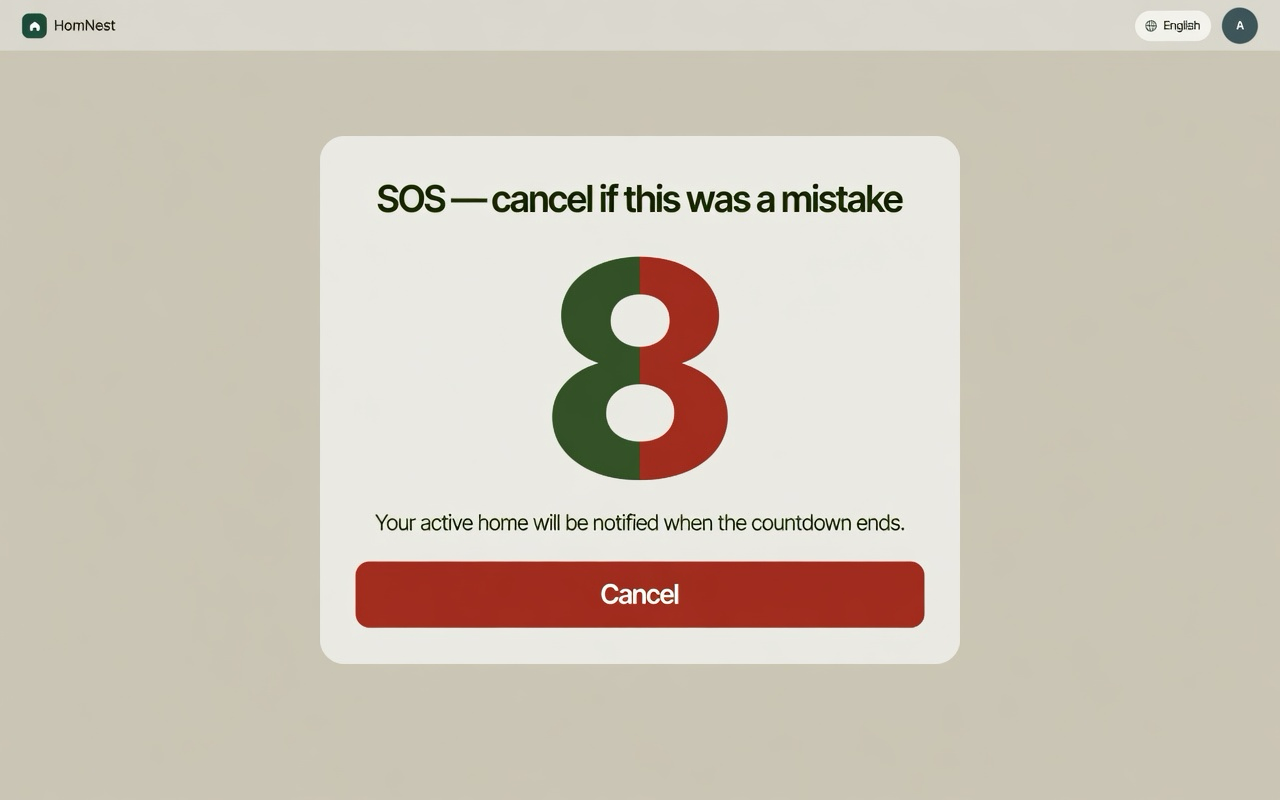
When something is actually wrong, a group chat is the wrong tool. Homnest SOS is a triple-tap, a ten-second countdown you can still cancel, then a critical push to the home — the kind that can break through Do Not Disturb. There is no SMS vendor and no extra number to remember.
If location sharing is allowed, the alert can carry an encrypted position. We still cannot read it. The point is that the people in the home are told, on the phones they already have, without waiting for someone to notice a missed call.
- Triple-tap, ten-second grace, then the home is notified.
- Critical push. No SMS company in the middle.
- Location can ride along, still end-to-end, only if the home's rules allow it.
One subscription. Everyone else is free.
Homes and roles
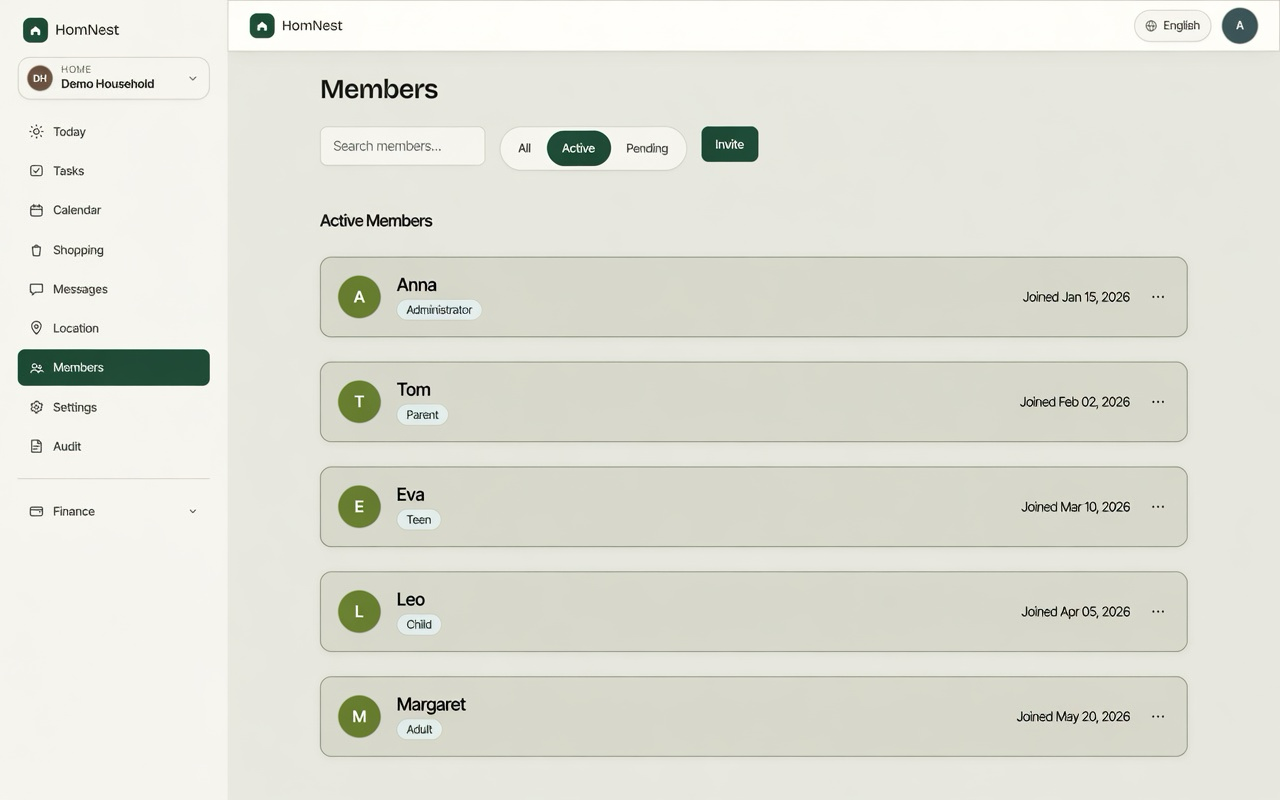
A home is not a list of email addresses. It is a set of people with roles: Administrator, Parent, Adult, Teen, Child, and custom groups if you need them. The administrator buys the subscription for that home. Every other member joins free — on the phone or at app.homnest.eu — and does not pay a second time.
You can belong to more than one home (a family home and a weekend home, two households after a split, help with parents). Each home is its own subscription. Inside a home, permissions are granular: a teen can share location without seeing the household money; a child can see their tasks without the adults' chat.
- One bill per home, no matter whether two people or twelve live there.
- Only the administrator pays. Members never buy a seat.
- Roles and custom groups, so a child and a parent are not the same kind of user.